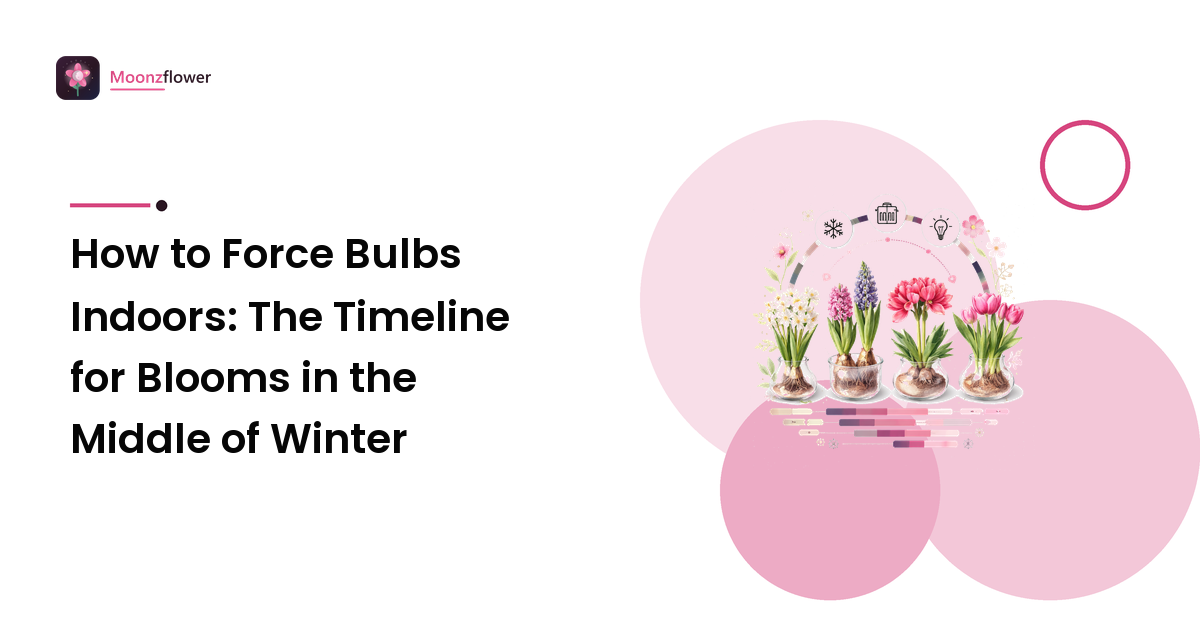
Forcing bulbs sounds like a specialist trick. It isn't. All you are doing is running a bulb's year on your schedule: giving it the cold spell it expects, then the warmth it is waiting for — indoors, in a pot, months before anything outside is flowering. Get that sequence right and a bare brown lump on a shelf turns into a hyacinth in full scent on a January windowsill.
The whole method comes down to one fact about bulbs and two families of them. This guide covers the fact, the split, and a timeline you can count backwards from a date you care about.
What "forcing" actually does
A mature flowering bulb is not a seed. It is a packed lunch with a flower already inside it. By the time you buy it, the bud for next season's bloom is formed in miniature at the centre, wrapped in scales of stored food. The bulb has everything it needs; it is simply waiting for permission.
For most spring bulbs, permission is a long cold period followed by warming. That is the signal that winter has passed and it is safe to spend the reserves. Forcing supplies both cues artificially — a cold, dark stretch, then heat and light — so the bulb performs on your calendar instead of the garden's.
This also explains the two classic failures. Cut the cold short and you get leaves without a flower stem, because the bulb never received a complete winter. Jump straight to a warm, bright room and you get a tall floppy stem, because the top raced ahead of a root system that had no time to anchor it.
The two families of bulbs
Before you buy anything, sort candidates into one of these. They need completely different handling.
Bulbs that need no chilling
Paperwhite narcissus and amaryllis (properly Hippeastrum) come from mild climates and skip the cold requirement entirely. Pot them, water them, put them somewhere warm, and they grow. These are the ones to choose if you have decided you want flowers indoors and you have weeks rather than months.
Paperwhites are fast, heavily scented, and single-use. Amaryllis is slower, produces a dramatic trumpet on a thick stalk, and — unlike almost everything else here — can be kept and rebloomed for years.
Bulbs that need a cold period
Hyacinth, tulip, crocus, daffodil, muscari and most other spring bulbs will not flower properly without a genuine chill. The requirement is measured in months, not days: think in terms of a couple of months for the quicker ones and closer to four for tulips, with the exact figure varying by species and variety. Take the number from the supplier or the packet rather than guessing — it is the one specification worth reading.
You can skip the waiting by buying bulbs sold as pre-chilled or "prepared". Those have already been through a controlled cold treatment, and they behave like the first family: pot and go.
The timeline, counted backwards
Decide the week you want flowers, then work back.
- Buy well ahead. Choose bulbs that feel heavy and firm with no soft patches, no mould at the base, and no shrivelled papery collapse. Size matters here more than with garden bulbs: a bigger bulb of the same variety carries more stored food and generally throws a stronger flower. Skip anything already sprouting hard in the bag.
- Pot them up. Set bulbs shoulder to shoulder, almost touching, with the pointed nose just above the surface of the compost. Crowding is the look you want — a lone bulb in a wide pot reads as an accident. Use a container with drainage, and a free-draining potting mix rather than heavy garden soil.
- Give the cold period (chill-requiring bulbs only). Somewhere dark, cold, and frost-free: an unheated garage, a cellar, a cold frame, a spare fridge shelf. Keep the compost barely damp — dry enough not to rot, moist enough for roots to form. Roots grow during this stage even though nothing shows on top.
- Check for roots before you bring them in. This is the step people skip. Tip a pot gently: you want white roots visible at the drainage holes and a firm nose pushing up. No roots means the bulb is not ready, whatever the calendar says.
- Wake them up in stages. Move the pot somewhere cool and dim first, then after a week or so into bright, cool light. That gradual step is what produces short, sturdy stems. Straight from cold storage into a hot bright room is exactly how you get a hyacinth that faceplants the week it opens.
- Bloom. From the move into light, expect a few weeks to flowering for most chill-requiring bulbs and a similar stretch for amaryllis from potting. Paperwhites are quicker.
Growing without compost: water and pebbles
Hyacinths and paperwhites both grow perfectly well without soil, which is why they turn up in glass forcing vases.
A forcing vase is shaped like an hourglass: the bulb sits in the neck, and the water level is set just below its base — close enough that roots reach down, never touching the bulb itself. A bulb sitting in water rots. Keep the water topped up to that line and change it if it clouds.
For paperwhites in pebbles, half-fill a bowl with gravel, nestle the bulbs so they are held upright but not buried, and add water to just below the base plate. They will send roots down through the stones and anchor themselves.
One well-known trick for paperwhites: they are famous for growing too tall and falling over in a warm room. Cool temperatures and bright light do most of the work of keeping them compact — the same lever that controls stem stretch in every other plant.
Troubleshooting: what went wrong
Leaves but no flower stem. The most common outcome, and almost always an incomplete cold period, a bulb that was too small, or a previously forced bulb with nothing left in the tank. There is no rescue mid-season; note it for next time. The same "all leaves, no flowers" logic applies to potted plants generally — the causes are laid out in our guide to why a flowering houseplant won't bloom.
Tall, floppy, pale stems. Too warm, too dim, or brought into the light too abruptly. Move somewhere cooler and brighter. Stake what is already leaning; you cannot un-stretch a stem.
Buds that form and then shrivel. Usually a sharp change — a hot radiator, a cold draught from a door, or the compost drying to bone. Steady temperature and steady moisture while buds develop.
A soft or smelly bulb. Rot, from sitting in water or waterlogged compost. Discard it; do not try to dry it out and replant.
Everything flowered at once and it is over. That is normal and the reason to stagger. Pot in two or three batches a fortnight apart and you extend the display across weeks instead of days.
After the flowers finish
Be realistic about which bulbs are worth keeping.
- Amaryllis: keep it. Cut the spent flower stalk, keep the leaves growing in good light and feed through the growing season, then give it a dry rest before starting it again. It reblooms happily for years.
- Hyacinths, tulips, crocus, daffodils: retire them from forcing. Forcing drains a bulb, and a forced bulb rarely performs well a second time in a pot. Plant them out in the garden once the foliage has died back naturally and let them recover on their own schedule; many will flower again outdoors after a year or two off.
- Paperwhites: compost them. They are effectively a one-season display in most climates.
One safety note worth repeating: narcissus, hyacinth, tulip and amaryllis bulbs are all toxic if eaten, and hyacinth bulbs can irritate skin. Handle them with gloves if you are sensitive, and keep pots and loose bulbs away from children and pets.
FAQ
How long do bulbs need to be chilled before forcing?
It depends on the species, and the range is wide — roughly two months at the short end to around four for tulips. The reliable move is to follow the period stated by the supplier for that variety, then confirm with the root test: if there are white roots at the drainage holes and a firm shoot emerging, the cold period did its job.
Can I force bulbs in water instead of soil?
Hyacinths and paperwhites, yes — that is what forcing vases and pebble bowls are for. Keep the water just below the base of the bulb so roots reach it and the bulb itself stays dry. Tulips and daffodils are far better off in compost.
Why did my forced bulbs grow tall and fall over?
Too much warmth and not enough light, usually made worse by moving them from cold storage straight into a heated room. Stems stretch toward light and elongate in heat. A cool, bright spot and a gradual transition keep them short and self-supporting.
Can I reuse forced bulbs next year?
Amaryllis, reliably. Most others, not for forcing again — the process uses up their reserves. Plant them in the garden after the leaves yellow naturally and treat any future flowering as a bonus.
Which bulb is easiest for a first attempt?
Amaryllis or paperwhites, because they skip the cold period entirely and are hard to get wrong: pot, water, wait. Move on to chilled hyacinths once you have somewhere reliably cold to store a pot for a couple of months.
Next Step
Pick your date first, decide whether you have months or weeks, and let that choose the bulb: chilled hyacinths and tulips if you are planning ahead, amaryllis or paperwhites if you want flowers soon. Then stagger the pots so the display lasts. If you also want to know what the bloom you are growing has traditionally stood for — narcissus for hope, hyacinth for constancy — the flower and meaning reference on Moonzflower has an entry for each, with the botany and the folklore kept clearly apart. For what is naturally in season while your pots are coming along, see our month-by-month guide to flowers in season, and for the bloom tied to a particular birthday, the birth flowers by month guide.