Walk into any flower market and you meet two words that get used almost interchangeably but mean different things: cut flowers and loose flowers. Getting them straight matters, because it decides how you buy, what you pay, and what you can actually make. This guide clears it up with plain definitions and concrete cut flowers and loose flowers examples, so you can tell at a glance which form a project needs — a vase, a garland, a table runner, or a handful of petals down the aisle.
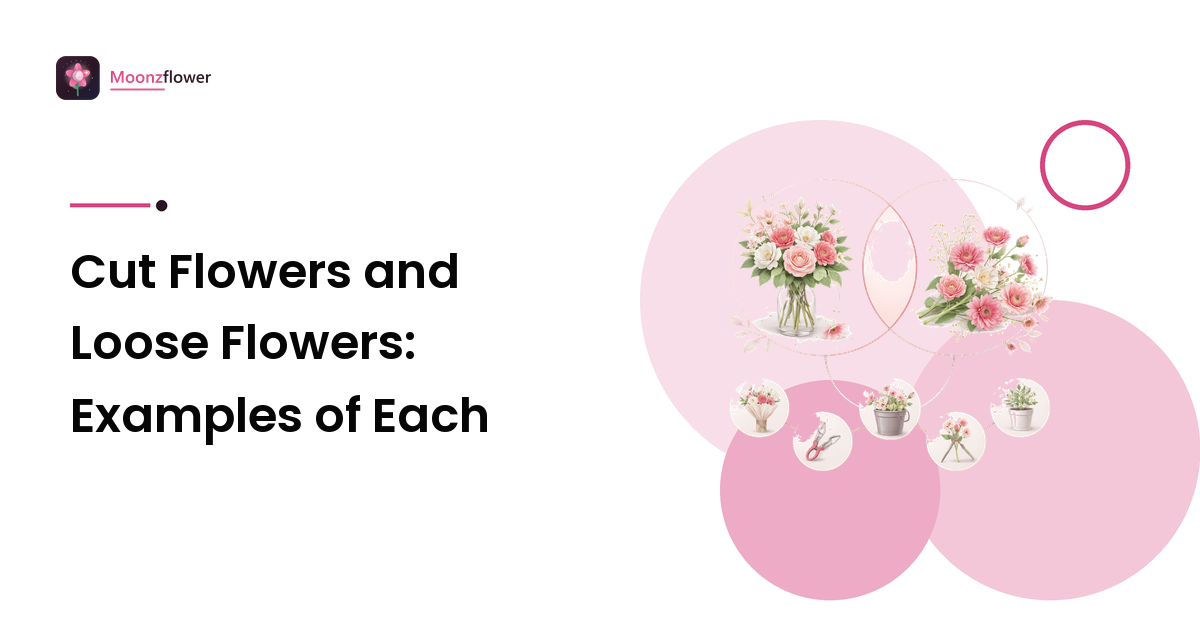
The short version: cut flowers are blooms harvested with their stems for display in water, while loose flowers are blooms sold unarranged — either as individual loose stems or as stemless heads and petals bought by weight. Below, examples of each, then how to choose.
What Are Cut Flowers? Examples
A cut flower is any bloom harvested with its stem intact and kept in water so it lasts for days in a vase or arrangement. The stem is the whole point: it carries water up to the flower, which is what gives a cut flower its vase life. When a florist builds a bouquet or a centerpiece, they are working with cut flowers.
Common cut flowers examples you will see almost everywhere:
- Roses — the classic focal stem for bouquets and romance.
- Tulips — soft spring stems that keep growing in the vase.
- Lilies — tall, fragrant, and long-opening down the stem.
- Chrysanthemums — sturdy, long-lasting, endlessly versatile.
- Carnations — ruffled, inexpensive, and remarkably durable.
- Gerbera daisies — bold, cheerful single-bloom stems.
- Sunflowers — big, structural summer focal flowers.
- Alstroemeria — clustered buds that open in succession.
- Snapdragons, delphiniums, and gladioli — tall "line" flowers that give an arrangement height.
Cut flowers are sold by the stem or by the bunch, and they are what you reach for when the goal is a bouquet, a vase display, or a floral centerpiece that sits in water.
What Are Loose Flowers? Examples
"Loose flowers" is where the confusion starts, because the phrase covers two related ideas.
1. Loose stems — flowers sold individually, not pre-arranged. These are still cut flowers with stems, but they come ungrouped so you can build your own arrangement. A DIY bride buying buckets of single stems to make her own centerpieces is buying loose flowers in this sense. Florists and wholesalers call them loose stems, and the appeal is control and value: you pick the exact mix and skip the labor cost of a ready-made bouquet.
2. Loose blooms — stemless heads and petals sold by weight or volume. These have little or no stem and are meant for decoration rather than a vase. Think of the marigold heads strung into garlands, the rose petals scattered down an aisle, or the jasmine used in fragrant strands. They are bought loose in bags or boxes, by the handful rather than by the stem.
Common loose flowers examples across both senses:
- Marigold heads — strung into garlands or piled for festival and event decor.
- Rose petals — aisle scatter, confetti, floating-bowl displays, and crafts.
- Jasmine — small fragrant blooms sold loose for strands and hair flowers.
- Chrysanthemum and carnation heads — pulled for garlands, backdrops, and flower walls.
- Orchid blooms — individual flowers used in leis and floating arrangements.
- Single loose stems of roses, tulips, or lilies — bought unarranged for DIY bouquets.
- Dried petals and buds — potpourri, sachets, and craft projects.
So the same rose can be a cut flower (long stem, headed for a vase), a loose stem (sold singly for you to arrange), or a loose bloom (petals in a bag for confetti). The form follows the job.
Cut Flowers and Loose Flowers Examples, Side by Side
Here is the distinction at a glance, with the typical use for each.
The dividing line is not the flower — it is the stem and how the flower is sold. If it comes with a stem for water, it behaves as a cut flower. If it comes loose by the handful for decoration, it is a loose bloom.
Best Cut Flowers to Grow
If you would rather cut your own than buy, the best cut flowers to grow are the ones that produce a lot, cut cleanly, and last in water. Reliable beginner performers include zinnias (the more you cut, the more they bloom), cosmos, dahlias, sunflowers, snapdragons, and sweet peas for scent. Choose varieties bred for cutting — they carry longer, straighter stems than bedding types — and harvest in the cool of early morning when stems are fullest of water.
Best Vase Life Flowers
When longevity is the priority, the best vase life flowers share two traits: dense or waxy petals and a modest thirst. Chrysanthemums and carnations lead the pack, routinely holding two to three weeks, with cut orchids, alstroemeria, and lilies close behind. Beautiful sprinters like peonies, dahlias, and tulips fade faster, so use them as accents inside a longer-lasting frame. However you buy — cut, loose stem, or bouquet — a clean vase and fresh water still decide how many of those days you actually collect.
Best Flower Food and Feeding Guide
Whether your flowers arrived as a finished bouquet or a bucket of loose stems, they want the same thing in the water. The best flower food is not a gimmick: a good sachet blends sugar to feed the bloom, a mild acidifier to help water climb the stem, and an antibacterial agent to keep the water clear. That trio beats any single-ingredient home remedy. A simple flower-and-garden feeding routine looks like this: dose the food to the packet instructions, top up or fully change the water every two days, and re-trim about a centimeter off each stem when you do. Skip the soda-and-aspirin folklore — it clouds the water more than it helps. For the full step-by-step, see our guide on how to keep cut flowers fresh.
Best Arranging Software and Planning Tools
Planning a big arrangement or an event is easier when you can see it first. If you are searching for the best arranging software, the useful tools fall into two camps. Event and floral-business platforms (such as stem-count calculators and floral CRMs) help pros price recipes and order the right quantity of loose stems. For home arrangers, a simple mood-board or design app — anything that lets you drag color swatches and reference photos onto a grid — does most of the job for free. The real planning wins are low-tech: decide your color palette, pick one or two focal flowers, and list your fillers and greenery before you buy. Tools help you count and visualize; they do not replace choosing good flowers.
FAQ
What is the difference between cut flowers and loose flowers?
Cut flowers are harvested with their stems for display in water. Loose flowers are sold unarranged — either as single loose stems for you to arrange, or as stemless heads and petals bought by weight for garlands, confetti, and decoration.
Are loose flowers cheaper than cut flowers?
Often, yes. Buying loose stems or loose blooms skips the labor of a ready-made arrangement, so you pay mostly for the flowers themselves. It is why DIY brides and event decorators buy loose and arrange their own.
Can the same flower be both cut and loose?
Yes. A rose can be a cut flower on a long stem for a vase, a loose stem sold singly for DIY arranging, or a loose bloom whose petals are bagged for confetti. The form depends on how it is harvested and sold, not the species.
What are loose flowers used for?
Loose stems are used for DIY bouquets and arrangements. Loose blooms and petals are used for garlands, hair flowers, aisle scatter, flower walls, floating-bowl displays, and crafts.
Do loose flowers last as long as cut flowers?
Loose stems kept in water last just like any cut flower. Stemless loose blooms and petals are meant for short-term decoration, so use them the day of your event and keep them cool and misted until then.
Choose the Right Form for the Job
Cut flowers, loose stems, and loose blooms are three answers to the same question — how do you want to use these flowers? A vase display wants cut stems; a DIY wedding wants buckets of loose stems; a garland or a petal path wants loose blooms by the handful. Once you know which form your project needs, buying gets simple and you stop overpaying for the wrong one.
When you are ready, order from Moonzflower and tell us the project — vase, DIY arrangement, or decor — and we will send farm-fresh flowers in exactly the form that fits, cut fresh and handled to last.