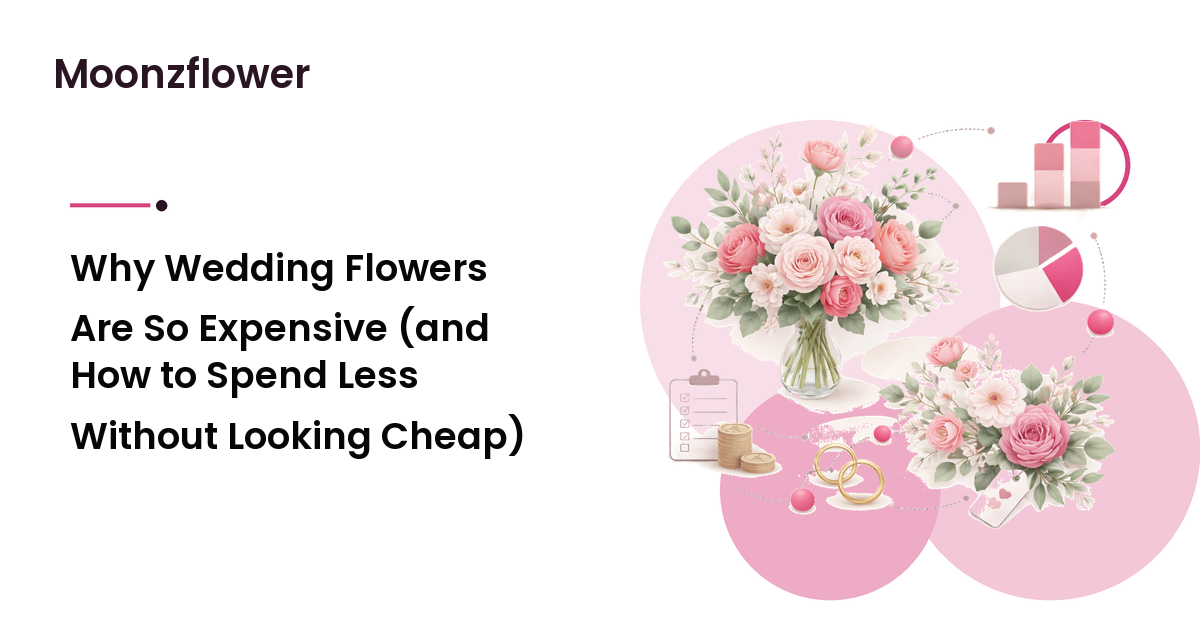
You send a florist a Pinterest board, ask for a quote, and the number lands far above what a few bunches of flowers "should" cost. The instinct is to assume you're being overcharged, and the first thing you type into a search bar is why are wedding flowers so expensive. Usually the answer isn't that you're being fleeced — you're just pricing the petals, and the petals are the small part.
The takeaway up front: most of a wedding flower bill is labour, logistics, and risk, not flowers. Once you see which line items are blooms and which are hours, you can cut the bill intelligently — trimming the expensive work you don't need while keeping the flowers where they'll be seen. Cut blind, and you pay nearly as much for a result that looks visibly cheaper.
Where the money actually goes
Picture your wedding flower cost split into four buckets. Couples assume it's mostly the first — it almost never is.
- The flowers themselves. The raw stems, conditioned and ready to use. Real money, but typically a minority of the total.
- Design labour. Hours spent processing stems, building each arrangement by hand, and styling on the day. A bridal bouquet is an hour of skilled work; a garland is several. This is the biggest hidden line item.
- Logistics. Sourcing, cold storage, a refrigerated trip, delivery, on-site setup, and often a return trip to break everything down. Flowers are perishable, heavy, and time-sensitive — a delivery problem with a deadline.
- Risk and waste. A florist orders extra in case stems arrive damaged, a variety comes up short, or heat wilts the delicate ones — the buffer that keeps arrangements full on a day that can't be redone.
This is why "but I saw those roses for a few dollars a bunch" doesn't translate. Supermarket stems are sold as-is; a wedding florist sells them conditioned, designed, delivered, installed, and guaranteed — and those last words are most of the price.
Why some flowers cost far more than others
Within the flower bucket, prices swing wildly — for concrete reasons, not arbitrary ones.
- Season. A flower at its local seasonal peak is abundant and cheaper. The same bloom forced out of season — grown under glass or flown across the world — costs a multiple. Peonies are the classic example.
- How fussy the bloom is. Hardy flowers travel and hold up; delicate, short-lived varieties bruise in transit and wilt in heat, so florists order extra and charge for the fragility.
- Size and density. Large focal flowers mean fewer but pricier stems; small flowers mean many stems and far more labour. Both routes to "lush" cost money, just in different buckets.
- Trend tax. When a flower goes viral for weddings, demand spikes and prices follow — a premium for the in-vogue choice over an equally lovely, less-hyped one.
None of this makes expensive flowers a rip-off. The price tracks real constraints — season, durability, and how many hands the look needs.
The part nobody warns you about: it's a labour bill in a flower costume
Here's the reframe that changes how you budget. When a quote feels high, the expensive part is rarely the flowers on the table — it's the number of things being made and the hours of installation. Ten centerpieces, a ceremony arch, an aisle of arrangements, and bouquets for the whole party isn't a flower order — it's a day of skilled labour plus a build-and-strike crew. Swap every bloom for something cheaper and you'd barely move the total; the cost lives in the count and construction, not the contents.
That's the good news: the biggest savings come from reducing the work, not haggling over stems — and done well, that's invisible to guests.
How to save on wedding flowers without looking cheap
Knowing how to save on wedding flowers comes down to one principle: spend where flowers are seen up close, and save where they're glanced at or cleared away early.
- Pick two hero moments, not ten. Guests remember the bouquet in every photo and the backdrop they stood in front of, not whether the third cocktail table had flowers. Fund those two properly; go minimal everywhere else.
- Let the florist choose in-season blooms. Give them a colour palette and a feeling rather than a fixed list. "Soft blush and cream, romantic and loose" buys far more flower per dollar than naming out-of-season varieties.
- Reuse arrangements across the day. Ceremony pieces can move to the reception; aisle arrangements become bar décor. One arrangement doing two jobs roughly halves its cost, and only your planner knows.
- Replace volume with greenery and candles. Foliage runners and grouped candles fill a table beautifully for a fraction of an all-flower equivalent. The eye reads "abundant"; the invoice reads "restrained."
The through-line: every one of these cuts labour or quantity, never the visible quality of the flowers. Thinning every item equally is what leaves a whole wedding looking diminished — that's the difference between spending less and looking cheap.
What's genuinely worth paying for
Cutting smart also means knowing what not to cut. Three line items earn their keep: the bouquet, in your hands all day and in nearly every photo; one strong focal installation — a backdrop, arch, or head-table piece, where one done well beats five done thinly; and a florist who'll design to a budget and tell you the truth about what's in season, what reuses, and where to skip. That honesty saves more than the fee — vague briefs and out-of-season wish lists blow budgets, not fair pricing.
The simplest pieces — bud vases, a loose welcome arrangement — are a real saving to make yourself; our beginner-friendly flower arranging guide walks through the layered technique. Leave the bouquet and any installation to a professional, though, where the stakes and skill are highest.
FAQ
Why are wedding flowers so much more expensive than a normal bouquet?
Because you're buying far more than stems: hours of hand-construction, sourcing and cold storage, delivery, on-site setup and breakdown, and a buffer of extra flowers so nothing looks sparse on a day that can't be redone. Labour and logistics are the bulk of it; the blooms are usually a minority.
What share of a wedding budget should go to flowers?
There's no single right number for a wedding flower budget — it depends on how flower-forward you want the day and how many arrangements you need. The more useful question is priorities: decide which one or two floral moments matter most, fund those, and keep the rest minimal. A good florist works backward from a stated total rather than pricing a wish list.
Do cheaper wedding flowers always look cheaper?
No — cheaper wedding flowers needn't read as cheap, as long as you cut labour and quantity rather than visible quality. Reusing arrangements, leaning on greenery and candles, and letting the florist pick in-season blooms all lower the bill while keeping what guests see looking full. Thinning every item equally is what reads as cheap.
Are in-season flowers really cheaper?
Yes, often by a lot. A flower at its local seasonal peak is abundant and priced accordingly; the same bloom forced or flown in out of season costs a multiple and is more fragile in transit. Giving your florist a colour and a mood instead of a fixed list is one of the biggest levers on cost.
Should I DIY my wedding flowers to save money?
You can save real money on the simplest pieces — bud vases, casual welcome arrangements — but leave the bouquet and any large installation to a professional. Those are the highest-stakes, most skill-dependent items, and the hardest to fix on the day.
Send your florist a budget, not just a board
Wedding flowers feel expensive because the price tag is mostly invisible: the hours, the cold chain, the setup, and the safety margin that keeps everything looking right on a day you only get once. See past the petals to the labour, and the savings reveal themselves — fewer pieces, in-season blooms, reused arrangements, all of it invisible to guests.
So lead with the number, not the wish list. Tell a florist your full budget and your top two floral priorities, and let them design backward from there. The couples who get the most flower for their money aren't the ones who haggle hardest — they're the ones who spend where it shows. When you're ready, start the conversation with Moonzflower.