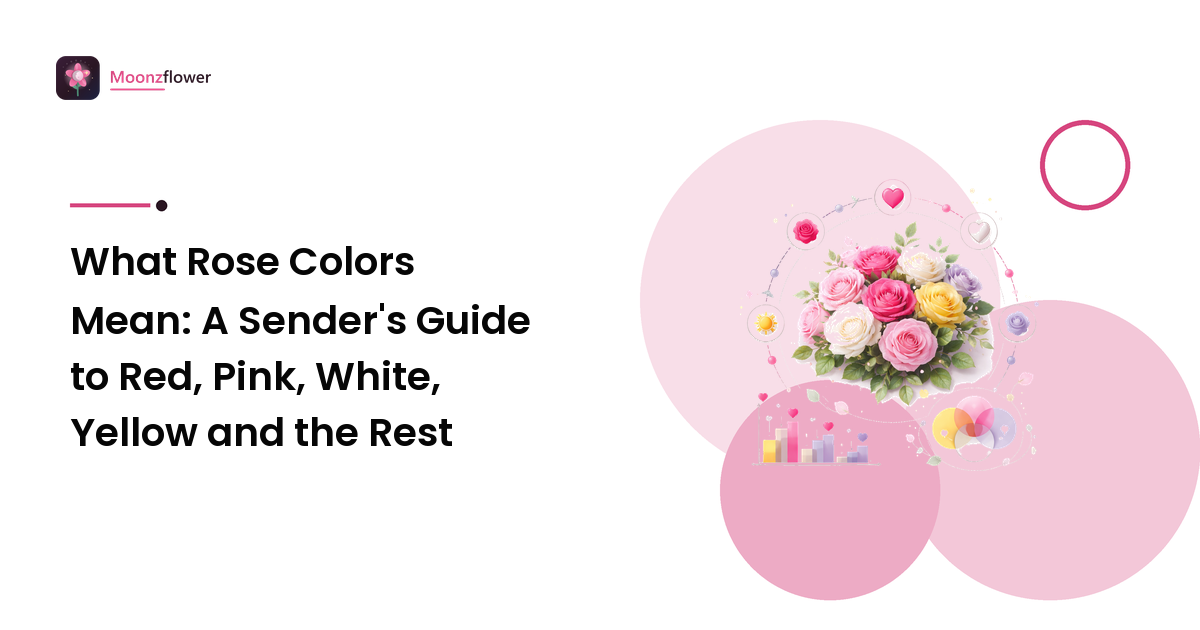
Someone is about to send roses and pauses at the colour choice, because they have half-remembered that yellow means something awkward and white might be a funeral flower. It is a reasonable worry, and it deserves a straight answer.
The takeaway up front: rose colour meanings are cultural convention, not botanical fact — and the conventions contradict each other, both across history and across cultures. Red for romantic love is the one association strong and consistent enough that almost every recipient will read it correctly. Everything else is softer than the internet suggests, and the practical rule is simple: choose the colour that suits the moment and the person, and let a card carry any message you actually need understood.
Here is where the meanings come from, what each colour has traditionally signalled, and where the traditions fall apart.
Where rose meanings come from
The idea that individual flowers carry specific messages is known as floriography, and its popular form dates to the nineteenth century. European and American publishers produced illustrated dictionaries of "the language of flowers" — Charlotte de la Tour's Le Langage des Fleurs in 1819 and Kate Greenaway's Language of Flowers in 1884 are among the best known — and the fashion spread widely enough that meanings entered common culture.
Two facts about those books matter for anyone taking their meanings seriously:
- They disagreed with each other. Different dictionaries assigned different meanings to the same flower, and later editions revised earlier ones. There was never a single authoritative list.
- They were a commercial and social fashion, not an ancient code. Some entries were inherited from older symbolism; others appear to have been invented to fill out a book.
So when you read that a particular colour "means" something, the honest phrasing is that it has traditionally been associated with that meaning in a particular time and place. That is not nothing — shared conventions are how gifts communicate at all — but it is not a rule the recipient is obliged to know.
Red — the one that reliably reads
Red roses signify romantic love, and this is the association strong enough to be effectively universal in cultures where roses are given at all. It is reinforced constantly by centuries of poetry, by Valentine's Day commerce, and by the simple fact that everyone knows it.
Practical notes: deeper burgundy and near-black reds read as more serious and less standard-issue than bright scarlet, and they photograph beautifully against pale foliage. True black roses do not exist — cultivars marketed as black, such as 'Black Baccara', are very dark reds that look near-black in shadow and clearly red in sunlight.
Send red when: the message is romantic and you want it unmistakable. Avoid red when: it is a work colleague, a friend, or any relationship where a romantic reading would be uncomfortable. This is the one colour that can genuinely say something you did not intend.
Pink — the most useful colour in gifting
Pink roses have traditionally carried gratitude, admiration, grace, and gentle affection, with paler pinks reading as softer and deeper pinks as warmer and more appreciative.
Pink is the workhorse of flower gifting precisely because it is warm without being declarative. It suits a thank-you, a new baby, a birthday, a recovery, a mother, a friend, a host. If you are stuck and the occasion is affectionate but not romantic, pink is very hard to get wrong — which is why so much of our flower gifting and etiquette guide ends up recommending it.
White — purity, reverence, and the culture question
White roses have been associated with purity, new beginnings, reverence, and remembrance. In practice they appear at both weddings and funerals in much of Europe and the Americas, which sounds contradictory but is not: the shared thread is solemnity and respect rather than a single emotion.
The cultural caveat matters here more than anywhere else. In several East Asian cultures white is strongly associated with mourning, and white flowers as a celebratory gift can read as inappropriate. If you are sending across cultures and are unsure, ask, or choose a colour with less freight.
White also has a practical advantage worth knowing: white and cream blooms show bruising and browning more visibly than dark ones, so they reward good handling. Our guide to keeping cut flowers fresh covers the vase hygiene and water routine that makes the biggest difference to pale petals.
Yellow — the meaning that genuinely changed
Yellow is the colour people worry about, and the worry has a real basis. In several Victorian flower dictionaries, yellow roses were assigned meanings around jealousy or a decline in affection. In modern usage — and this shift is well established — yellow roses read overwhelmingly as friendship, cheerfulness, and warmth.
This is the clearest example of the whole point of this guide: a nineteenth-century dictionary entry does not govern how a bouquet is received in a kitchen today. Unless your recipient is a floriography enthusiast, yellow roses will be read as sunny and friendly. They suit get-well gifts, congratulations, new jobs, and friends of any kind.
Orange, peach, lavender and coral
- Orange roses carry enthusiasm, energy, and desire in most modern lists — a warmer, more emphatic cousin of yellow. Good for congratulations and celebrations that want some volume.
- Peach has traditionally been linked to gratitude and sincerity, and it is a quieter, more sophisticated choice than either pink or orange. It suits thank-you gifts and professional contexts particularly well.
- Lavender and purple roses are associated with enchantment and love at first sight, partly because the colour is unusual and slightly otherworldly. They are also simply beautiful in mixed arrangements.
- Coral sits between pink and orange and carries the warmth of both without a strong assigned meaning of its own, which some senders find freeing.
Blue roses deserve a note of honesty: roses do not naturally produce the pigment for true blue. Blue roses in shops are either dyed, or they are the genetically modified varieties developed to contain delphinidin — Suntory's Applause rose is the well-known example — and those read as mauve rather than blue in person. If someone loves blue flowers, delphiniums, irises and hydrangeas will serve them better than a dyed rose.
Mixed bouquets, and how many to send
Mixing colours dilutes any single message, which is usually a feature rather than a bug. Red-and-white together has a traditional association with unity, and it is a common wedding and anniversary combination. Pink-and-white reads as gentle and celebratory. A mixed warm bouquet — yellow, orange, peach — reads as cheerful and carries no romantic implication at all.
On quantity, the conventions are commercial rather than ancient. A single red rose reads as a deliberate, restrained romantic gesture; a dozen is the standard romantic bouquet in most Western markets; and larger counts are simply larger. Odd numbers are conventional in some European traditions and even numbers in others, with the reverse being the funeral convention — another case where local custom beats any universal rule. If you are sending internationally, the florist filling the order locally is the best source on what is customary there.
Choosing without overthinking it
A sequence that works:
- Name the relationship honestly. Romantic, affectionate, grateful, sympathetic, celebratory. Only the first has a colour you must get right.
- Rule out the two risks. Red where romance is not intended; white where the recipient's culture reads it as mourning.
- Pick for the person. Their favourite colour, or the colours in the room the flowers will sit in, beats any dictionary entry.
- Write the card. Roses cannot say "thank you for covering for me last month." Three handwritten lines can.
That last step is the one that makes the whole colour question much lower-stakes than it looks. If the meaning matters enough to worry about, it matters enough to write down.
FAQ
Do yellow roses really mean jealousy?
Some Victorian flower dictionaries assigned yellow roses meanings around jealousy or fading affection, but modern usage has settled firmly on friendship and cheerfulness. Unless your recipient specifically follows historical floriography, yellow roses will be received as warm and friendly.
Are white roses appropriate for a wedding or a funeral?
Both, in much of Europe and the Americas — the common thread is reverence rather than a single emotion. The important exception is that white is strongly associated with mourning in several East Asian cultures, so for cross-cultural gifting it is worth checking or choosing another colour.
What colour roses should I send to a friend or colleague?
Pink, peach, or yellow. All three read as warm and appreciative without any romantic implication, which red carries whether or not you intend it. Peach in particular suits professional thank-you gifts.
Is there a real blue rose?
Not naturally. Roses lack the pigment pathway that produces true blue, so blue roses on sale are either dyed or the genetically modified varieties developed to contain delphinidin, which appear mauve in person. For a genuinely blue flower, look to delphiniums, irises, or hydrangeas instead.
Does the number of roses mean something?
The conventions around quantity — a single rose, a dozen, odd versus even numbers — are commercial and regional rather than ancient, and they differ between countries. A local florist is the most reliable guide to what is customary where the flowers are being delivered.
Want the meaning behind the flower rather than just the colour? Look up what each flower traditionally means on Moonzflower — symbolism and folklore, kept clearly separate from botanical fact.