Most couples start wedding planning with a florist in mind and end up needing something bigger. The florist quote comes back covering bouquets, buttonholes and table arrangements — and the questions that are actually keeping you up at night are about the entrance, the stage, the lighting, the drapes, and how a bare banquet hall turns into the room in the photographs you saved.
That gap is not a florist failing at their job. It is the line between two related trades, and knowing where it falls saves you money, double-booked work, and the very common outcome where nobody owns the overall look and the day arrives with a beautiful set of flowers scattered around a room nobody styled.
The clean distinction
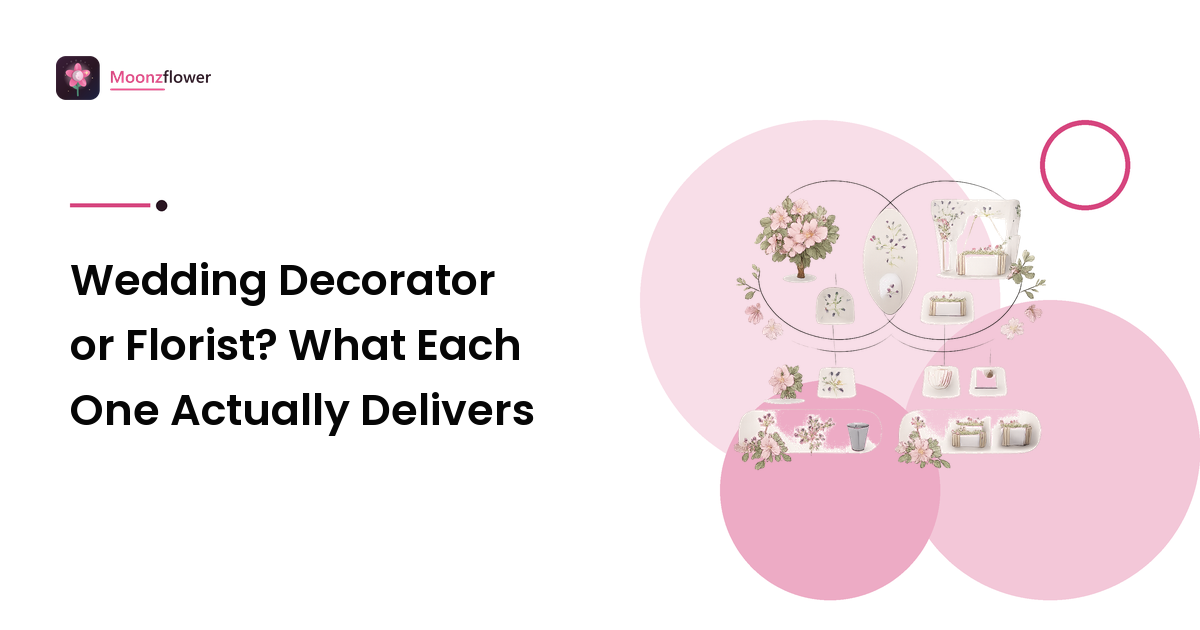
A florist works in fresh flowers. Sourcing, conditioning, arranging: bouquets, buttonholes, garlands, centrepieces, sometimes an arch or an installation. Their craft is botanical — which blooms are in season, what survives eight hours out of water, how a colour reads under warm light.
A wedding decorator works in space. Their raw materials include flowers, but also fabric, structure, furniture, lighting and props — and their deliverable is a finished environment: the entrance you walk through, the stage or mandap, the backdrop your photos are taken against, the ceiling treatment, the seating layout, the aisle. A decorator is closer to a set designer than a gardener.
The overlap is real, which is why the confusion persists. Many decor teams employ florists or subcontract them; many florists will happily quote for an arch or an aisle. The practical question is not "who can supply flowers" but who is responsible for how the whole room looks when the doors open. Exactly one vendor should hold that answer.
Signs your wedding needs a decorator, not just flowers
You are firmly in decorator territory when any of these are true:
- The venue is a blank box. A banquet hall, a lawn, a community hall or a shell of a marquee gives you nothing to build on. Everything the guests see has to be brought in and installed.
- There is a stage, a mandap, or a focal structure. Anything guests will sit facing for hours, and anything the couple will be photographed on, is a build — structure first, florals second.
- Multiple functions across days or rooms. A mehndi, a sangeet, a ceremony and a reception need a look that carries across all of them without repeating itself. That is design work, not four separate flower orders.
- Lighting matters to you. Uplighting, fairy-light canopies, and warm washes on a backdrop change photographs more than any single arrangement does — and they are almost never in a florist's scope.
- You want one person accountable. The moment two vendors both "sort of" own the ceremony space, you are the one coordinating them on the morning of your own wedding.
If none of those apply — an intimate ceremony in a venue that already looks good, where you need bouquets and a dozen tables dressed — a florist alone is the right, cheaper answer. Buying a decor package for a room that needs almost nothing is a genuine way to waste money.
What a full-service decor brief usually covers
When a decor team quotes properly, the scope tends to break into the same blocks, and it is worth knowing them so you can read a quote critically:
Structure and staging — the stage, mandap, arch, or backdrop, including the frame nobody sees. Fabric and drapery — ceiling treatments, wall drapes, backdrop layers, table linen. Florals — fresh, dried, or artificial, and increasingly a mix; a decorator will tell you honestly where artificial reads fine in photographs and where only fresh will do. Lighting — ambient wash, focal lighting on the stage, and the practical lights the caterers and photographers need. Furniture and props — seating, sofas for the couple, welcome signage, entrance features. Install and strike — the hours before, and the often-forgotten clearing afterwards, which venues charge for if nobody has planned it.
Teams that also run the wider event — coordination, vendor management, timings — sit in the event-management category rather than pure decor. Roses and Beyond, an India-based wedding-decor and event-management outfit, is an example of that combined model: the same team that designs the room also manages the sequence of the day, which is the arrangement that removes the most work from the family.
Where the money actually goes
Decor quotes surprise people because the visible flowers are rarely the biggest line. Labour and structure usually are: a stage backdrop takes a crew, a truck, and a build window before guests arrive, plus a strike afterwards. Fresh flowers are volatile in price by season and can swing a quote by a wide margin, which is why decorators reach for a mix of fresh, dried and quality artificial in the areas guests never see up close — a legitimate technique, not a cheat, and one worth asking about directly. Our guide to planning wedding flowers that photograph beautifully covers the flower half of that decision in more depth.
Two other cost drivers hide in plain sight: venue restrictions (no fixings in the walls, a two-hour access window, mandatory in-house suppliers) and the number of separate spaces you are dressing. Both are cheap to ask about and expensive to discover late.
Questions that sort a good decor vendor from a risky one
Ask these before you compare prices, because the answers change what the price means:
- What exactly is in this quote — and what is not? Get install, strike, lighting and transport itemised. "Decor: full setup" is not a scope.
- Have you worked at this venue? Someone who knows the access rules, the ceiling height and the power supply is worth a premium.
- What happens if a flower variety is unavailable that week? The honest answer is a substitution policy, not a promise.
- How many events are you handling that day? A team that is stretched across three weddings does its third one badly.
- Who is on site during the event? Somebody senior should be reachable after the install, not just during it.
- Can I see full-event photos, not just close-ups? Wide shots reveal whether the room was designed or just decorated.
FAQ
Can a florist do everything a decorator does?
Some can, especially florists who have grown into full-service events. But the moment a build is involved — a stage, a mandap, drapery, lighting — you need to confirm they own that scope with their own crew, rather than assuming flowers imply structure.
Should I hire the decorator or the venue's in-house team?
In-house teams know the room and the rules, which is genuinely valuable, but their look is often fixed. An external decorator gives you design freedom at the cost of coordinating access. Ask the venue whether outside decor is even permitted before you fall in love with an idea.
Is booking one team for decor and event management actually safer?
Usually, yes — one accountable party removes the gaps that appear between vendors, and the timings and the look get planned together. The catch is that a single vendor is also a single point of failure, so it matters more that they are experienced, contactable, and specific in writing about what they will deliver.
How far ahead should decor be booked?
Earlier than most people expect, because good teams take a limited number of dates in peak season. A first conversation twelve months out is normal; by six months you are choosing from what is left rather than who you want.
Next step
Before you collect a single quote, decide which thing you are buying: arrangements, or a whole room. Write down the spaces that need to change, the functions involved, and what the venue will and will not allow — that one page turns vague quotes into comparable ones. If a combined decor and event-management team fits the wedding you are planning, talk to a specialist like Roses and Beyond early, while your date is still open on their calendar.